For Toni Morrison:
I regret the fact that I was only introduced to Toni Morrison’s work after her death. When I was in high school, and even in college, assigned readings were primarily authored by white men. Of course, there was the occasional woman – I read Mary Shelley’s Frankenstein three times as a student, and it remains one of my favorites – or person of color – namely Chinua Achebe’s Things Fall Apart, which was part of the AP-level curriculum, and I do not know if the grade-level students were exposed to Achebe, or any other authors of color for that matter. I ascribe this foresight to growing up in a predominantly white neighborhood and attending predominantly white K-12 schools (not that that is an excuse; I implore white teachers to adjust their curriculum to include heterogeneous voices as they are able).
I regret the fact that I was only introduced to Toni Morrison’s work after her death, as I was preparing to teach it myself to a class of predominantly Black 11th graders. While I was free to choose the curriculum I taught, a rarity I was excitingly grateful for, Morrison was on one of the lists of recommended novels. The school already had class sets of The Bluest Eye, but I had been handed Beloved and was enraptured by Morrison’s voice from the first page, excited for a historical horror, not considering that the brokenness in the narrative might be too heavy for teenagers (not that the brokenness of The Bluest Eye is much better, but if you’ve read Beloved, you get what I mean). The school approved an order for copies of Beloved and 100 teens and I were set to read it in the spring semester.
What I especially appreciated, after I made the switch to The Bluest Eye, was the community made in my classroom for that unit. I waited until the spring semester not for time (we already had the books) but for trust; there was no way I was going to throw childhood trauma at children who barely knew me. But by January, they knew me, they trusted me, and they were ready to discuss heavier topics than something more removed, like our first semester short stories or The Great Gatsby. I started that unit with a conversation on self-image and what beauty meant to us now; thankfully, it has changed since I was younger, and my students were much more confident in loving themselves than I would have been. One way we had that conversation was through a rare benefit of the Zoom Age: anonymous onscreen responses in real time. I posed a few questions that were met with honest answers – If you could change something about yourself, would you? If your friend was jealous of someone’s appearance, what would you say to them? Why do you think someone might not like themselves? – and one shining, beautiful answer came in, not in direct response to the question but in response to the serious mood shift in the room: “I want you to know you’re all great people and I’m here for you.” The kids are going to be alright. And I don’t think I would have gotten that response without the help of dear Toni Morrison.
I do not regret the fact that I was introduced to Toni Morrison as an adult, ready for the analysis, ready for the voice, ready to connect to her writing as a writer myself. I do think Morrison is right for younger ages, but even though I was a reader, I did not like many of the texts assigned to me. I wanted fantasy, I wanted contemporary voices, I wanted casual dialogue; I did not yet appreciate the need to read in order to write better. I was reading for fun (valid). I was not yet reading for fun and knowledge (my current purpose). I don’t think I would have appreciated her as much when I was younger. I do wish I had been exposed to more diverse and varied literature in school, but maybe that would have changed the drive I had to provide that as a teacher and being open about that conversation with my students.
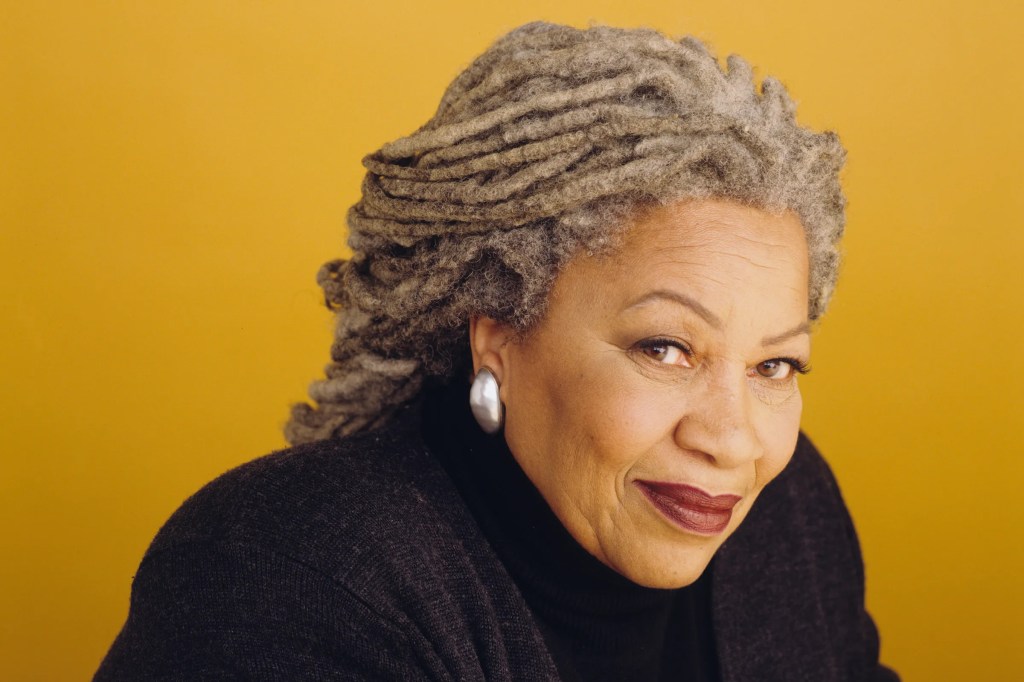
I remember the distractions of preparing my lessons for Beloved and The Bluest Eye. I always introduced a novel with its author, especially when there was a way for students to see them, hear them, understand them. Harder to do with F. Scott Fitzgerald, wonderful to do with Toni Morrison. The way she speaks about writing – about life, about people – is entrancing. I often found myself watching videos of her for my own interests before I realized I was meaning to find a video for a lesson. Her voice pulls me in and doesn’t let me go; and obviously that isn’t just her audible voice, but her writing voice – though I am listening to her read the audiobook for Jazz and it is easily the best way to read her books.
Click the image above for a Business Insider list of recommended reads by Toni Morrison.
I have not yet made my way through Morrison’s bibliography. I push that day off because I know there are no more books to come. I regret the fact that I was only introduced to Toni Morrison’s work after her death. But when I do read her books – or reread The Bluest Eye for the nth time – I pore through her words for advice, for lessons beyond the social and moral commentary of her novels. I want to climb inside her mind and sit there until I can emulate the poetry of her prose. Though I admire a great number of writers and there are a great number of works that inspire me and my writing, there are few so visceral moments as that of thinking about Toni Morrison, patron saint of writers who strive for truth.
If you have not yet read Toni Morrison, I hope you get the joyful opportunity to do so. If you are a reader, her writing is a warm and serious hug. The kind you get from a friend who wants only what is best for you and for your growth as a human being. She does not shy away from the ugliness and disparity of humanity, but she also holds close the beauty of people and our language. If you are a writer, she is the light, the ink, the push to be better, write better, write more. Or if not her, I hope you find your writing idol too.


 Mia Powell
Leave a reply to Mia Powell Cancel reply